A snapshot of reported incidents reviewed over fourteen days in Toronto, the Greater Toronto Area and selected surrounding Southern Ontario communities. These figures are not a national assessment, a population-adjusted comparison or evidence of a change in crime rates.
FOURTEEN DAYS · 9–22 NOVEMBER 2026
6 incidents involving gunfire.
7 people shot. 3 killed.
12 stabbing incidents.
At least 12 people stabbed. 1 killed.
3 home invasions.
These are the minimums identified in our review of police releases and credible local reporting across Toronto, the Greater Toronto Area and selected surrounding Southern Ontario communities over fourteen days, from 9 to 22 November 2026.
They are not official region-wide totals or a complete record of crime. Fatalities are included within the victim counts. One gunfire incident involved shots fired at an occupied property without a reported shooting victim.
The figures deserve attention. So do the settings: residential streets, family homes, shopping centres and the familiar places where people conduct their everyday lives.
Even in places we associate with safety, serious incidents warrant attention. The practical question is whether our precautions reflect our circumstances, rather than assumptions about where we live.
Familiar surroundings do not remove exposure
At approximately 3:45 a.m. on 15 November, police responded to gunfire near Yonge Street and Eagle Street West in Newmarket. Officers found damage to a garage door and a vehicle parked in the driveway. The home was occupied. Nobody was reported injured, and police had not established a motive in their release.2
Three days earlier, at around 1:40 p.m., armed suspects allegedly forced their way into a Bowmanville home and assaulted the homeowner. Durham police reported serious, non-life-threatening injuries. This happened in the early afternoon, with nearby schools placed under hold-and-secure measures.3
In Hamilton, police reported that three suspects entered a home on Weathering Heights shortly before 2 a.m. on 11 November and assaulted three occupants. All three received hospital treatment for non-life-threatening injuries. The motive remained unknown.4
These incidents do not establish that every neighbourhood faces the same threat, or that the attacks were random. They demonstrate why familiarity alone is a poor basis for judging security.
A quiet street tells you something about its everyday character. It tells you much less about a particular household’s exposure.
Affluence cannot guarantee protection
The Bridle Path home invasion on 29 October, outside the November snapshot, provides a particularly stark example.
According to Toronto Police, three suspects carrying firearms and a hammer forced entry into a home near Post Road and Hyde Park Circle. They went upstairs and demanded valuables. During the confrontation, three occupants sustained gunshot wounds. Two occupants, including one of those shot, were struck with a hammer. All four were taken to hospital.1
The security lesson concerns the relationship between possessions and people. An offender seeking valuables may confront the person who can provide access to them. Once that happens, an incident with a financial objective can have devastating physical consequences.
That distinction matters when assessing residential security. Preventing the loss of possessions and protecting occupants are related responsibilities, but they require different decisions during an emergency.
Vehicles and valuables can bring confrontation closer
On 19 November, a driver sitting in a Mercedes SUV outside a coffee shop in Oakville was approached by a man carrying a handgun. Police said the offender demanded the keys, ordered the driver out and drove away. No physical injuries were reported.5
In a separate incident on 13 November, two masked suspects approached a man leaving Toronto Premium Outlets in Halton Hills. According to police reporting carried by HaltonHillsToday, they demanded his jacket, jewellery and keys before taking his BMW. No weapon was seen and no physical injuries were reported. The vehicle was subsequently recovered.6
Both involved direct confrontation. They should not be confused with theft from an unattended vehicle or the theft of a parked car.
Residential exposure can also be connected to vehicles. In its 12 November board remarks, Toronto Police said it was investigating 107 home invasions that year and had observed an increase in break-and-enters committed to steal vehicles. The statement did not supply equivalent comparison figures, so it cannot establish the size of that increase.7
The practical implication is that the home, driveway, vehicle and person carrying the keys should be considered together. Security arrangements that treat each in isolation can overlook how exposure moves between them.
When a person becomes the route to business assets
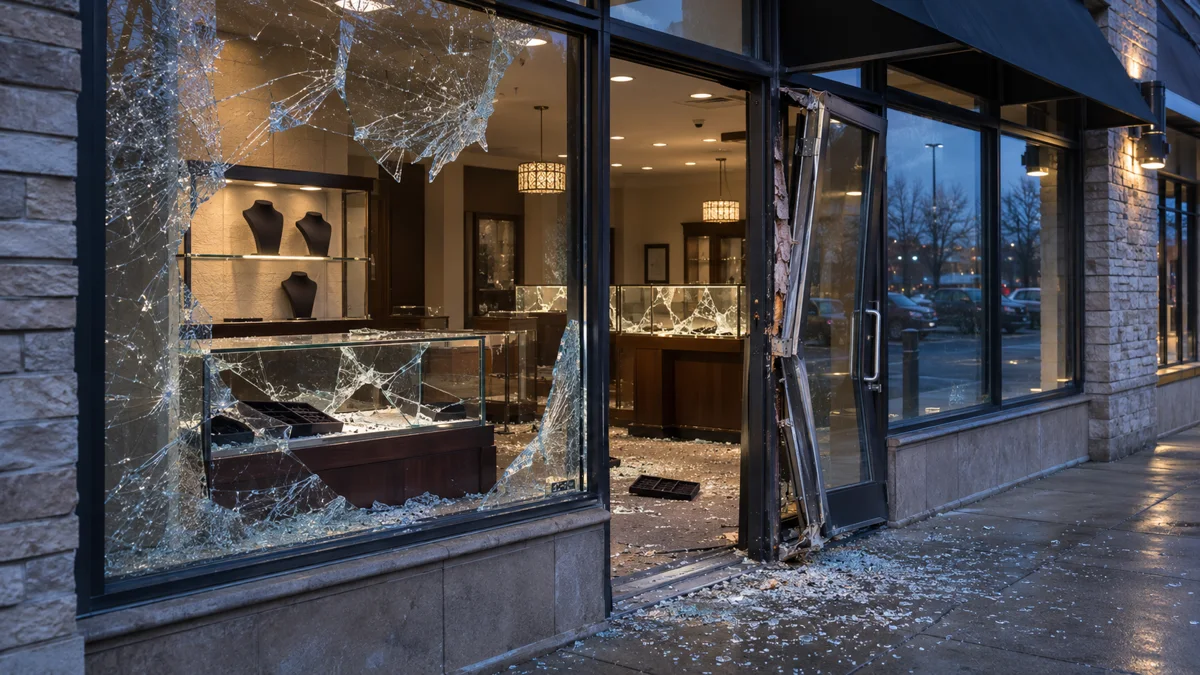
The exposure extends to business premises and the people working inside them. On 16 November, a stolen pickup truck was driven into R&R Jewellers in Hamilton before masked suspects carrying sledgehammers stole jewellery and merchandise. CHCH reported that one employee sustained minor injuries.89
Six days earlier, Kris Jewelers in Burlington was robbed after suspects used hammers and an axe to force entry. Police reported stolen jewellery but no physical injuries to staff.10
For business owners and executives, personal security can also intersect with access to corporate assets.
Toronto Police allege that a cryptocurrency-exchange owner was abducted at gunpoint near Finch Avenue East and Bayview Avenue on 25 July 2026. Investigators said he was handcuffed and assaulted as the suspects attempted to obtain access to cryptocurrency assets and business-related security systems. He was later released after threats and a warning not to contact police.11
This case illustrates a risk that technical controls alone cannot fully address: an individual with access or authority can become the target of coercion.
Regional extortion investigations provide another example. In May 2026, Peel Regional Police announced an investigation involving threats and violence against South Asian business owners and community members. Police connected 17 accused to 24 incidents, including 16 violent incidents associated with an alleged criminal network. The reported conduct included shootings and arson.12
These cases establish that deliberate attacks on business owners occur. They do not, by themselves, demonstrate that executives generally are being targeted more frequently.
For those responsible for a business, the relevant assessment includes who controls valuable assets, whose routines are visible and whether threats affecting the organisation could follow someone home.
A disappearance may initially tell an incomplete story
On 7 July 2026, a man was reported missing from his business near Denison Street and Woodbine Avenue in Markham.
York Regional Police said information gathered at the scene established that he had been kidnapped. Investigators located him safely on 9 July.13
The distinction between the initial report and the subsequent finding is important. At the beginning of a disappearance, relatives, colleagues and investigators may have incomplete information. The circumstances become clearer as evidence emerges.
It would be wrong to infer that missing-person cases generally involve abduction. A missing-person report is not a kidnapping count, and combining the two would misrepresent both.
The useful lesson is to recognise unexplained departures from someone’s normal behaviour and communicate relevant concerns promptly. Uncertainty about what has happened should encourage careful attention, without turning speculation into fact.
Falling crime figures deserve recognition
Any credible assessment must acknowledge improvement.
Statistics Canada’s 2025 figures show the national Crime Severity Index fell by 5%, including a 4% reduction in its violent component. This index measures police-reported crime, taking account of both volume and severity.14
Toronto Police’s 2025 Annual Statistical Report records 158 home-invasion robberies, down 6.5% from 169 in 2024. Vehicle jackings fell 20.4%, from 221 to 176, and reported auto thefts fell 23.9%, from 9,748 to 7,421.15
Those improvements matter. A selection of disturbing incidents cannot overturn them or establish that violent crime is rising across the GTA.
Equally, an improving regional picture cannot determine the exposure of a particular household or business. Overall frequency, individual circumstances and potential consequences are different considerations.
Precision matters here too. An attempted break-in is not a completed home invasion. A stolen vehicle is not necessarily a carjacking. An injury reported after an incident is not automatically a gunshot or stab wound.
Sound security judgement depends on preserving those distinctions.

Confidence should have a foundation
Proportionate vigilance begins with understanding how you live: your routines, your property, the information you disclose and the assets you can access.
It means asking whether physical security, household habits and emergency arrangements work together. It means recognising that a familiar journey or an ordinary evening can still contain moments of exposure.
None of this requires living in constant fear. It requires enough attention to distinguish reassurance from preparation.
A prestigious postal code is not a security strategy.
Canada’s reputation cannot assess your circumstances, recognise a developing concern or decide how your household would respond.
The question is whether your confidence in your personal security rests on what you have examined and prepared for, or simply on what you have always assumed.
References and reporting note
The fourteen-day figures are reviewed-report minimums from the incident register, not an official statistical series. Follow-up releases are treated as updates to existing incidents. Unspecified additional injuries are excluded from confirmed shooting and stabbing victim counts. Sources reviewed 23 November 2026.
- Toronto Police Service: Bridle Path home invasion update, 16 November 2026
- York Regional Police: Newmarket shooting, 20 November 2026
- Durham Regional Police: Bowmanville home invasion, 13 November 2026
- Hamilton Police: Weathering Heights home invasion, 12 November 2026
- Halton Regional Police: Oakville carjacking, 20 November 2026
- HaltonHillsToday: BMW robbery at Toronto Premium Outlets, 16 November 2026
- Toronto Police Service: Board remarks, 12 November 2026
- Hamilton Police: R&R Jewellers robbery, 16 November 2026
- CHCH: Hamilton jewellery-store robbery, 17 November 2026
- Halton Regional Police: Burlington jewellery-store robbery, 13 November 2026
- Toronto Police Service: Cryptocurrency-business owner kidnapping, 14 October 2026
- Peel Regional Police: Extortion investigation, 25 May 2026
- York Regional Police: Markham kidnapping update, 24 July 2026
- Statistics Canada: Police-reported crime in Canada, 2025
- Toronto Police Service: 2025 Annual Statistical Report, pp. 17 and 21-22